laura

Laura Batson


Senior Software Engineer

Coding is fun! It's solving puzzles and challenging you to think in new ways. I've worked at tiny startups of about twenty people and at global media and healthcare organizations reaching millions of users. I love the fast pace of startups and getting to be a major part of creating a product. At larger companies I love the resources available and knowing the broad impact of my work. I'm a full-stack developer with background of creating customer facing products. I'm always looking to expand my knowledge and stay current with the latest technologies. I think AI is here to stay and I love working faster by using and guiding it.

I'm proud to have been a co-director of Women Who Code Atlanta. Even with the closing of Women Who Code Global, I continue to support the tech community in Atlanta and promote the growth and success of underrepresented groups in tech through Refactr.tech. When I'm not on my computer, I'm spending time with my family, reading, and making things. Ask me what book I'm reading anytime!
A few of the problems I've been handed over the years, and what happened next. Names and logos left out on purpose — the interesting part is the work.

Cleared a Three-Month Safety Backlog

An AI assistant's flagged responses needed human review under strict data privacy rules, and the queue was up to a three-month backlog. Digging into the reporting data, I found that almost half of everything flagged traced back to a single false-positive pattern. Retiring that one rule cut the volume dramatically, and I built the triage process and documentation so any on-call engineer could keep the queue current weekly.

Turned a Build-vs-Buy Question Into a One-Sprint Win

Product wanted a fully custom emoji picker; the design was beautiful and the estimate was heavy. Rather than push back or just build it, I researched the real options and brought stakeholders a clear side-by-side of speed versus customization. We shipped a well-chosen off-the-shelf solution inside a single sprint. Users loved it immediately, and the custom styling nobody missed stayed safely in the backlog.

Led a Feature Through Every Edge Case

I led an extension to a collaborative feature that changed use based on permissions. The behavior looked simple until you asked the real questions — what happens with two admin users, or when a new admin is added? Is an admin able to alter any users content? I built a decision matrix, worked through each case with product, and shipped with every scenario defined. I also wrote the documentation the original feature had never had, which outlived my part of the project.

Replaced a Legacy UI Layer Ahead of Schedule

I joined a startup as the senior front-end engineer to strip out an aging component framework and replace it with custom UI. As the only front-end-focused developer, I had real autonomy over the approach, and I chose reusable, composable components that could later be lifted into a proper library. The team had budgeted far longer; I finished in under six months, and handed the foundation to the next front-end hire before I left.

Rewrote a High-Traffic Site in React

I was a major contributor on the rewrite of a heavily trafficked site from an early JavaScript framework into React, my first real experience with a shared component library and design system. Two of my three teammates were new to React and one was new to JavaScript entirely, so a lot of the work was translating technical decisions for mixed audiences and teaching as we went. It turned into two-way mentoring — I learned as much about large-scale architecture as they learned about React.

Shipped a Design System Against a Public Deadline

A brand-new internal design system landed on my team with a launch date already announced publicly. The components didn't match how our app actually passed state, so we designed an adapter layer of wrapper components to get the new system into production on time — then went back and methodically retired that layer over the following months. We hit the date, the product looked great, and the team stayed intact and working well together through a genuinely frustrating stretch.

Learned a Niche Language to Ship on TV

Moving onto a streaming-TV team meant picking up BrightScript, a language used almost nowhere else, and learning the constraints of set-top boxes and smart TVs. I got productive quickly by leaning on what carries across languages rather than starting from zero, and shipped features to devices for millions of users. It's a great reminder that the fundamentals transfer further than the syntax does.

Became the Go-To for Experimentation

On a mature, high-traffic product I became the subject-matter expert on our A/B testing platform, working closely with the analytics team to make sure experiments produced data people could actually act on. For one test I built out an independent backend and API just to organize the results properly. I also took 24/7 monitoring shifts during a major national election, watching dashboards through the highest-traffic nights of the year.

Built a Mobile App From Scratch

At a company of under twenty people, I built a React Native app from an empty repository with one other engineer, owning the UI side end to end for a complex product that paying customers depended on. The piece I'm proudest of is a drag-and-drop scheduling interface: no existing package did what we needed, so I took an open-source foundation apart and rebuilt it to our requirements. It taught me more about ownership than any project since.

Also worth mentioning

  • Migrated a product's rich-text editor off an unmaintained library onto a modern replacement, which resolved long-standing accessibility problems and unblocked a major framework upgrade.
  • Tracked a stubborn cursor-jump bug deep into a third-party editor's internals and shipped a fix for users without forking the whole library.
  • Worked cross-functionally with architects to build and debug internal application tooling, including the build pipeline and bundler configuration behind a shared React starter.
  • Rebuilt my own approach to sprint planning early in a role — going deep on refinement and scoping before committing — and turned inconsistent delivery into reliably hitting my commitments.
  • Used cost-based reasoning to settle a technical disagreement, translating implementation choices into dollar figures so the whole team could evaluate the trade-off on the same terms.

These are my earliest projects, from 2017. For current work, see my GitHub.

A snapshot of my capstone projects from bootcamp in 2017. These were originally hosted on Heroku and are no longer actively deployed, so the images below stand in for the live sites. They're here to show projects I owned start to finish, very early on.

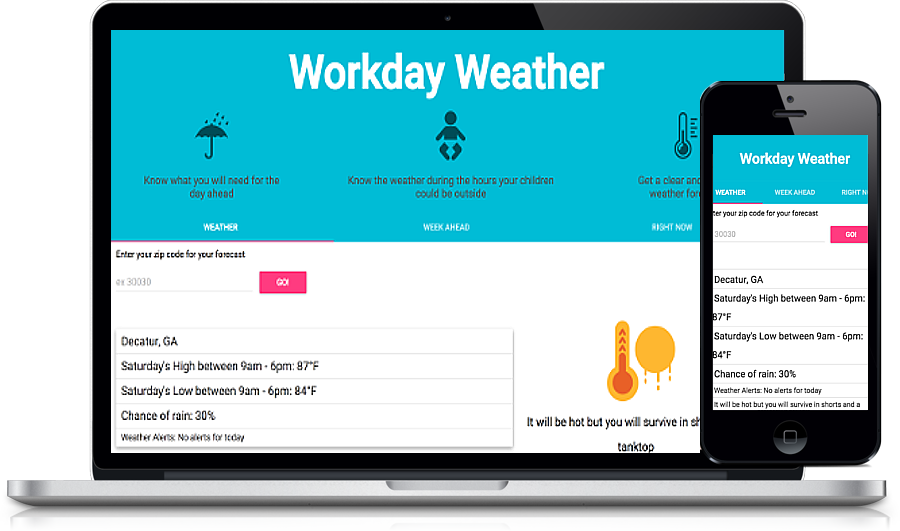
Workday Weather app screenshot

If you check the weather frequently, you are probably aware of how frustrating and bloated the popular weather websites are. I spend a lot of time outside and I like to be prepared. I decided to build this app to make accessing my basic local weather forecast quick and easy (the default city is even my hometown so it's extra quick for me!). I utilized the Weather Underground API for my information and the Material UI library to make my UI/UX streamlined.

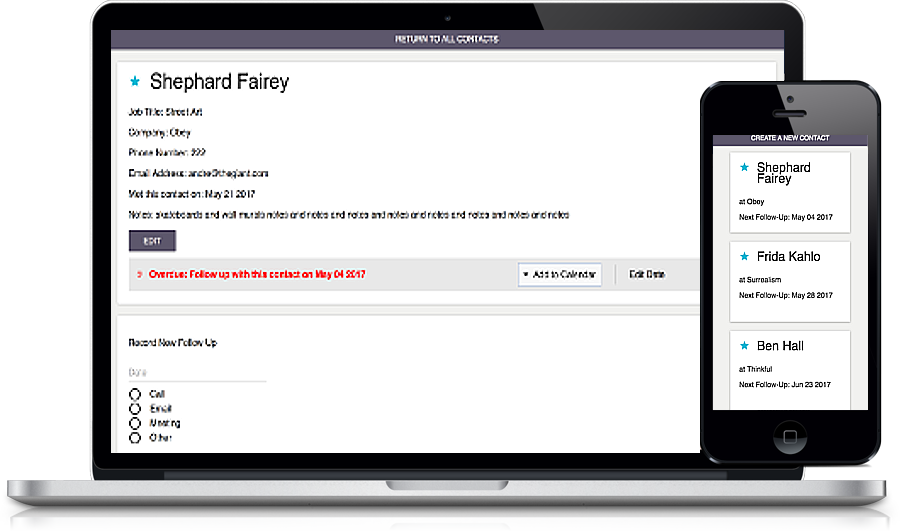
Networker app screenshot

For my final capstone, I decided to work on a project that could be helpful in my job search. The idea of this is a CRM software app that focuses on networking with contacts. Having one place for contact information, notes about meetings and follow-ups, and sorting and scheduling capabilities help keep your professional network manageable. I've included functionality to push followup reminders to a personal calendar. I've also implemented secure login functionality. While I currently only have contacts included in this app, I want to add on a job search category that would allow a user to keep their job hunt organized as well.

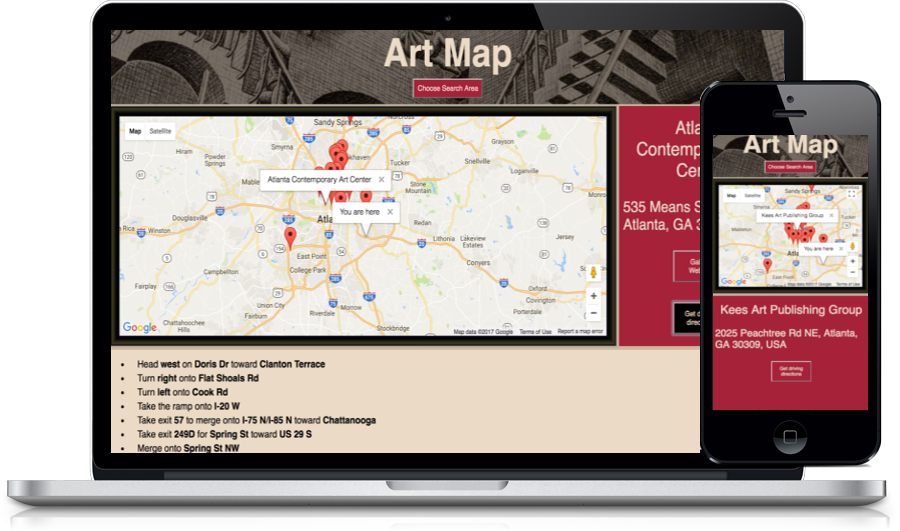
Art Map app screenshot

This was my first official capstone project I completed at bootcamp. After a few false starts where I learned more about APIs and what makes them good to work with, I decided to create a map that helps you find local art galleries to visit wherever you happen to be. I used Google Map's API for geolocation and Google Places to find information about galleries. To add more to this project, I returned recently and updated the project to include available driving directions to each location.

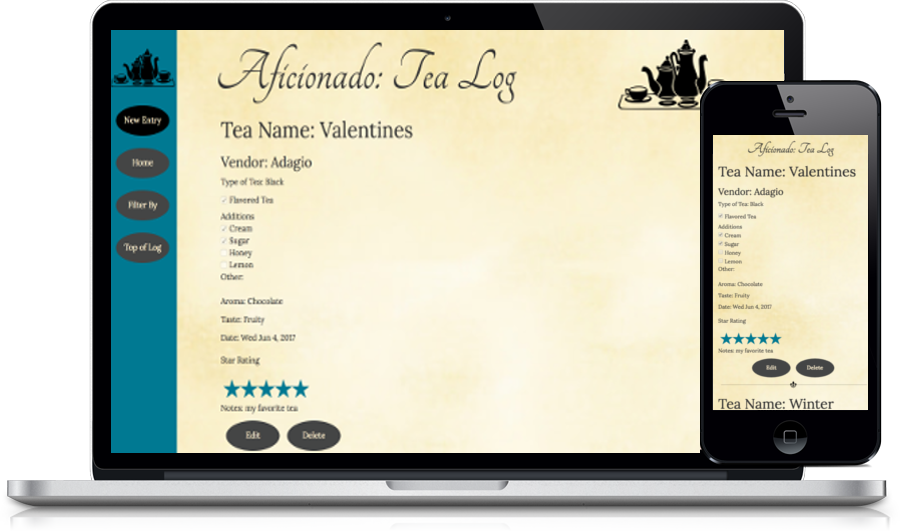
Tealog app screenshot

One of the best ways to become an expert on something you enjoy is to journal about your experiences with it to compare and contrast. This is a well known technique for those who wish to become more knowledgeable about wine. I personally don't care for wine, but I love tea and my original idea for this project was to create a journal that can be customized to record any experience including tea tastings, wine, and beyond. To keep this project to scale in the limited time I had during bootcamp, I focused on making this a digital diary for tea. I hope to scale the project up in the future to help document all types of experience.

Find Me on the Web


I'm happy to talk shop, trade notes on front-end architecture, or hear about what you're building.